
Technical Requirements Template
Purpose:
Technical requirements are specifications that guide usage of: data, software, processing environments/platforms., outputs, and hardware needed during solution production. This template walks the solution team through technical components required for a solution and that should be considered and included in solution design.
Proactively considering the technical requirements of a solution early in the co-development process is vital for efficient collaboration and meeting deadlines. Though most dialogue on the user's technical requirements will arise during co-design, keep in mind that important information about needs and preferences is likely to arise even earlier. For example, a user may mention their preferred software or computing limitations during preliminary stakeholder engagements.
Also, note that some stakeholders who are newer to geospatial tools or Earth observations may not have clear preferences or may be unsure of certain technical specifications, so they may require more thorough conversation to fully understand their requirements. Teams should be attentive to user needs that come up during Phase 1 and other Phase 2 tools and remember to document them in this template.
NASA Earth Action Solutions Co-Development Toolkit, v0.1 | 72
How and When to Use This Template:
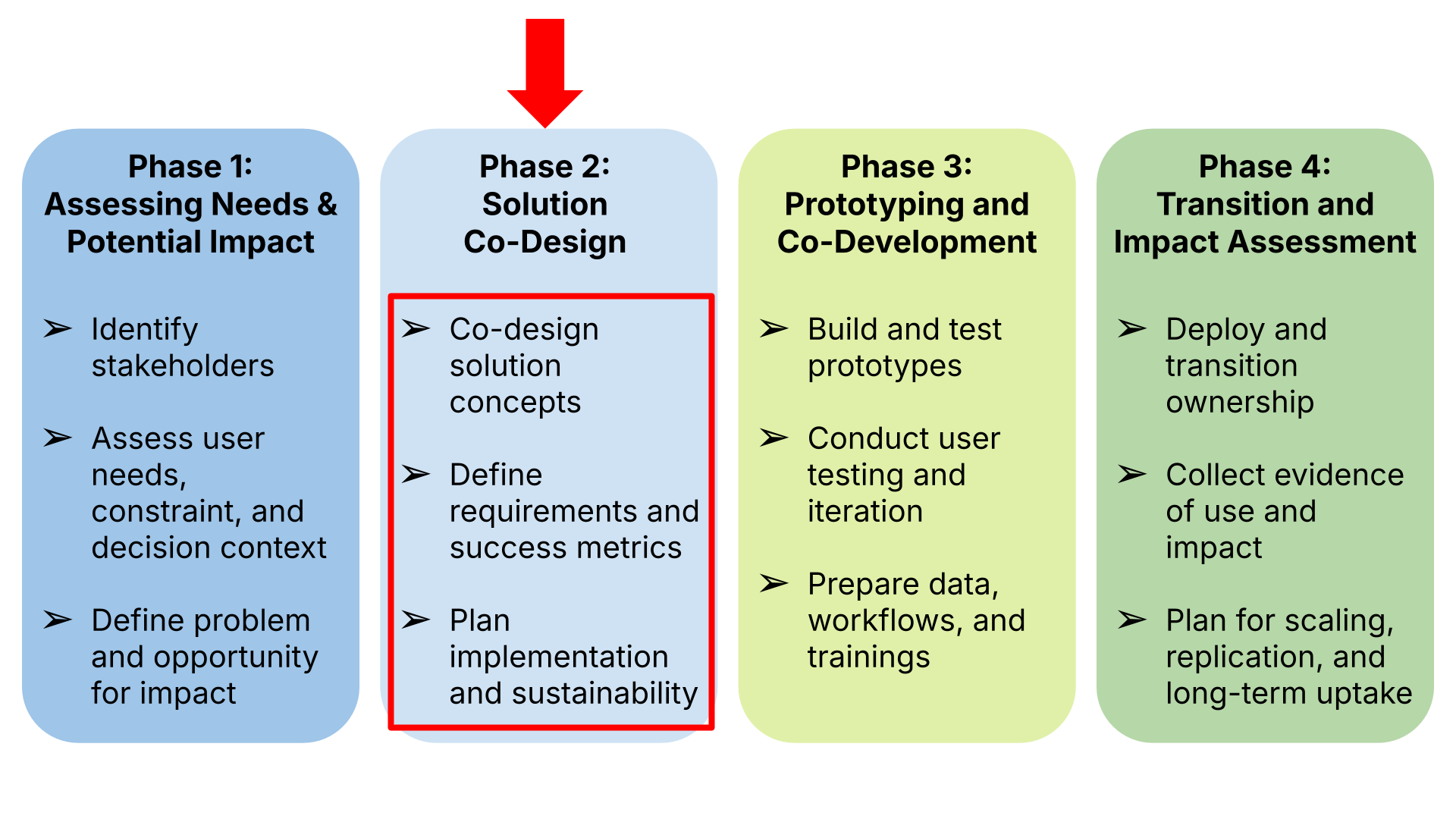
This template is used at the beginning of Phase 2 of the co-development framework once a solution team starts designing the solution. Referencing the Stakeholder mapping, Needs Assessment, and the Design for Impact tools provides understanding of the needs and the objectives of the solution, it documents who the stakeholders are, the beneficiaries and the deliverables.
Key Questions for Co-Development Partners open editable template
Do you need to establish agreements to co-design with partners? If yes, provide a link to the collaboration agreement as feasible. If agreement is not shareable, just indicating that there's an agreement in place that enables collaboration and captures the elements indicated in this section should be sufficient. Types of sample agreements (all indicating collaboration roles) include:
- Email confirmation
- Signed meeting minutes confirming collaboration and partner roles
- Letter of collaboration
- Interagency agreement
- DAACS agreement
- Legal collaboration agreement
- External partners collaboration agreement
Do you need to establish data-sharing agreements? If yes, provide a link to the data sharing agreement. Include confidentiality and non-disclosure agreements NDAs) where necessary.
Is the data available under open access mechanisms or is it private data? Does the data access and sharing need encryption? Do you have a mechanism for data encryption? If yes, ensure to include a data encryption tool in the list of software needed.
NASA Earth Action Solutions Co-Development Toolkit, v0.1 | 73
What are the roles and responsibilities for each partner? Include a link to the roles and responsibilities for partners
Please ensure these agreements are in place to streamline co-development processes.
- Do you need to establish communication channels for co-developement?
- Do you have tools/software in place for everyday exchange and meetings?
How will user feedback be collected before production? Identify the timing of when to collect feedback at different stages of the solution co-development lifecycle. Feedback will need to be integrated into the new design.
What are the inputs at different stages of development?
- Inputs for Development and Testing
- Inputs for Deployment
- Inputs for System Maintenance
- What are the outputs desired?
- What is the minimum viable product?
- Does it address the user's needs? Feedback from stakeholders at this stage should determine the outputs are satisfactory
- Does it integrate stakeholders feedback?
- Does it have considerations for future use?
NASA Earth Action Solutions Co-Development Toolkit, v0.1 | 74
Technical Requirements | Example Specifications
-
Data source 1 (can be cloud-based such as Cloud Optimized GeoTIFFs (CoGs) or downloadable to local stations)
- Access: (Open Access, purchase required)
- Spatial Resolution: (m, cm)
- Spectral Resolution: (no of bands)
- Latency: (Days, Hours)
- Level of Analysis Readiness: (Processing Level)
- Data source 2
- Data source 3
- Stakeholder mapping tool (provide link)
- Needs Assessment tool (provide link)
- User Centered Design (provide link)
- Code 1:
- Dependencies
- Code 2..
- Code 3...
- Output 1, format (can be cloud-based or downloadable)
- Output 2, format
- Spec 1
- Spec 2...
NASA Earth Action Solutions Co-Development Toolkit, v0.1 | 75
- Do the results meet the validation thresholds?
- Test and retest prototype/system before deployment.
- If successful then you can proceed to deployment.
- Does the system and results meet intended needs?
- Does the UI/UX meet user requirements?
- Spec 1
- Spec 2...
- Is deployment Successful?
- Did it meet the Minimal Viable product?
- Does it meet the user requirement based on the User Centered Co-Design Guidance?
NASA Earth Action Solutions Co-Development Toolkit, v0.1 | 76