
Solution-Level Stakeholder Mapping and Analysis
Purpose:
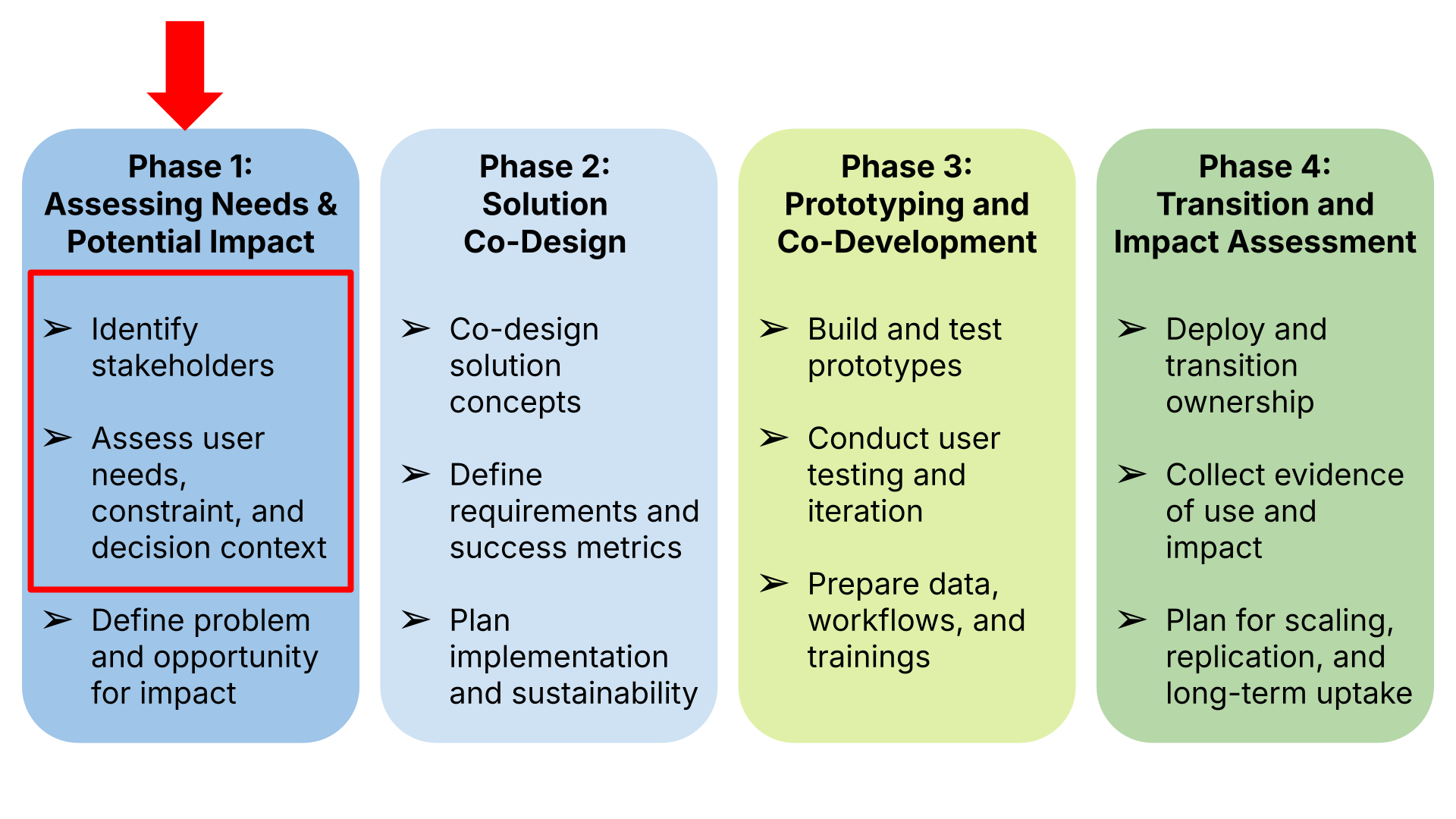
This is a rapid-fire tool designed to help NASA teams identify, prioritize, and engage key stakeholders around an emerging Earth observation (EO) solution. It is designed to provide a clear, actionable picture of who is relevant to the solution, their interests, and how best to engage them. It is not exhaustive, and instead aims to generate enough insight to guide co-development, outreach, and planning. This tool helps accomplish the Stakeholder Identification and Mapping step of the Solution Implementation Plan and Designing for Impact tool.
How and When to Use This Tool:
NASA Earth Action Solutions Co-Development Toolkit, v0.1 | 40
The Stakeholder Mapping Tool should be used after a preliminary real-world need has been identified along with potential opportunities for NASA Earth science to address that need. Use this tool early in the scoping/intake process when all users and/or stakeholders are not fully identified to clarify stakeholder roles, influence, and potential interest in engagement. This tool can and should be used iteratively, updating as relationships, workflows, and priorities evolve.
Outputs of this tool will include:
- A Stakeholder Map
- A Stakeholder Analysis Snapshot (interest, influence, relationship readiness)
- Near-term engagement priorities for Phase 1
Building the Mapping Team:
Establish the working group/team that will be responsible for conducting stakeholder mapping. A core team of three to five people is recommended to include: 1) a defined lead, 2) relevant technical EO specialist(s); 3) social science or engagement specialists (as available/needed); and 4) An economist or impact analyst (as needed).
Steps
Working as a team, list all potential stakeholder types and institutions in column A connected to the EO opportunity. This is about breadth—cast the net wide.
A note on overlap in stakeholder types:
If a stakeholder fits into multiple categories, consider what their primary and secondary role is. Those might be the highest value stakeholders and should be flagged for deeper engagement. For example, a stakeholder who is both a user and a beneficiary would be a great candidate for co-design and user testing.
NASA Earth Action Solutions Co-Development Toolkit, v0.1 | 41
| Category | Definition / Role | Key Characteristics / Responsibilities | Examples (note that example actors could fit into multiple categories depending on the given solution) |
|---|---|---|---|
| Users | Anyone who interacts directly with EO-enabled products, data, services, workflows, or insights to make decisions, perform tasks, enable systems, or deliver value to others. This group is especially useful for providing early demand signals for internal reporting. |
|
|
| Beneficiaries | People positively affected by decisions, services, or interventions derived from EO solutions. May not directly interact with the data but are critical for impact-driven design. Quotes from this group drive impactful storytelling. |
|
|
| Enablers (critical intermediaries) | Institutions or actors that enable, support, or block use, adoption, or impact of EO solutions. There are important intermediaries that are often critical for identifying risks and assumptions in the Solution Planning and Design for Impact stages. Helpful for defining real-world value of solutions and connecting to beneficiaries who can provide quotes for impactful storytelling. |
|
|
NASA Earth Action Solutions Co-Development Toolkit, v0.1 | 42
Understand the current state of connection and credibility between your team and each stakeholder, independent of whether the stakeholder cares about or will benefit from the solution.
What "relationship readiness" means:
Relationship readiness describes how prepared your team is to engage a stakeholder based on existing access, trust, and ownership.
Assess:
- Whether a relationship already exists, is emerging, or must be initiated
- Who on the team is best positioned to engage (based on role, credibility, or prior contact)
- Review existing NASA relationships (use EAX)
- Any known constraints or enablers to initiating or deepening engagement
Categories:
- Established: ongoing relationship with trust and regular interaction
- Nascent: limited or informal contact; relationship is developing
- To Be Initiated: no prior relationship; engagement must start from scratch
Rate each stakeholder's influence (ability to shape or enable a solution/impact) and interest (level of anticipated engagement with or benefit from the solution) on a simple 1–4 scale.
Influence:
The stakeholder's ability to enable, block, shape, or scale the solution or its impact.
Examples:
- Decision authority or policy control
- Control over resources, data, or implementation pathways
- Ability to legitimize or operationalize outcomes
Interest:
The degree to which the stakeholder's mandate, responsibilities, or outcomes are affected by the solution—not their current awareness, enthusiasm, or engagement level. Interest reflects structural relevance, not relationship strength.
Examples:
- Alignment with a stakeholder's mission or operational goals
- Direct benefit from the outputs or outcomes
- Exposure to risks the solution addresses
NASA Earth Action Solutions Co-Development Toolkit, v0.1 | 43
Based on the results of Step 3, decide on the pathways for engagement with each stakeholder based on the influence/interest nexus. Categorize whether to Collaborate, Align, Validate, or Monitor. (These will help in the Co-Design step).
| Engagement Type | Influence / Interest | Engagement Approach |
|---|---|---|
| Collaborate | High Influence, High Interest | Deep, two-way engagement; stakeholders actively shape the solution. |
| Align | High Influence, Low Interest | Keep informed and coordinated; ensure activities and policies remain consistent. |
| Validate | Low Influence, High Interest | Periodic check-ins to confirm assumptions, gather feedback, and test design decisions. |
| Monitor | Low Influence, Low Interest | Light-touch tracking; detect shifts in interest or influence that may affect the solution. |
Capture 3–5 takeaways:
- Who are your:
- main users?
- beneficiaries?
- enablers, including critical allies and potential champions?
- Where are major engagement gaps?
- Which stakeholders can start engaging with immediately?
NASA Earth Action Solutions Co-Development Toolkit, v0.1 | 44
Proposed Workflow / Timeline
- Include complementary perspectives (technical, engagement, economic) without creating a large committee.
- Use the mapping outputs to inform planning, not as an end in itself.
- Iterate as needed; this is meant to be a living document as new stakeholders may emerge during all phases.
| Activity | Led By | Output | Notes |
|---|---|---|---|
| Define scope & criteria | EO Program Manager + Social Science / Local Engagement Lead | Purpose statement + prioritization matrix | Keep scope narrow (single service or problem area) |
| Draft stakeholder list | EO Technical Lead + Team | Initial mapping table | Use internal network + existing partner lists (ex. EAX) |
| Validate & expand | Social Science Lead + Economist + Team | Updated list with influence, impact, and engagement potential | Include policy, and economic dimensions |
| Visualize & brief | EO Team | Map + summary | Can be built directly from Excel |
| Leadership review | EO Program Manager | Prioritized stakeholder map + engagement plan | Output feeds into planning or proposals |
NASA Earth Action Solutions Co-Development Toolkit, v0.1 | 45