
User-Centered Design
Purpose:
User-centered design (UCD) is a structured, evidence-based approach to solution development that ensures systems are designed around the real-world needs, decision contexts, and constraints of the people who use them. Grounded in human–computer interaction research, UCD emphasizes iterative engagement with users to ensure that solutions are usable, useful, and aligned with operational realities.
In applied Earth science, UCD bridges scientific capability and decision support. High-quality data or applications generate impact only when they are interpreted, trusted, and used to inform action within defined authority structures and time constraints. UCD therefore translates validated stakeholder and workflow insights into concrete design requirements and testable hypotheses about how improved information delivery can influence decision behavior and contribute to measurable outcomes and impacts. UCD is built upon human-system principles, which pivot on designing tools and technologies to function effectively within the roles of constraints specific to the people who use them.
Why is UCD Relevant to NASA?
NASA has long applied related human-systems and usability principles in mission design, flight and ground operations, and safety-critical environments, where threshold clarity (clear conditions that trigger action), interaction flow (how users move through information to act), and decision support directly affect performance. Within applied Earth science, UCD extends this discipline to EO-enabled applications and services, ensuring that solutions are not only technically sound, but decision-ready. Studies of EO-based decision support highlight that credibility, salience, and workflow fit determine whether information is acted upon.
UCD operationalizes stakeholder and workflow insights by defining how a solution must function to influence real-world decisions. It ensures that technical development remains aligned with decision timing, authority structures, usability constraints, and intended behavioral change across all phases of co-development.
NASA Earth Action Solutions Co-Development Toolkit, v0.1 | 68
How and When to Use This Tool:
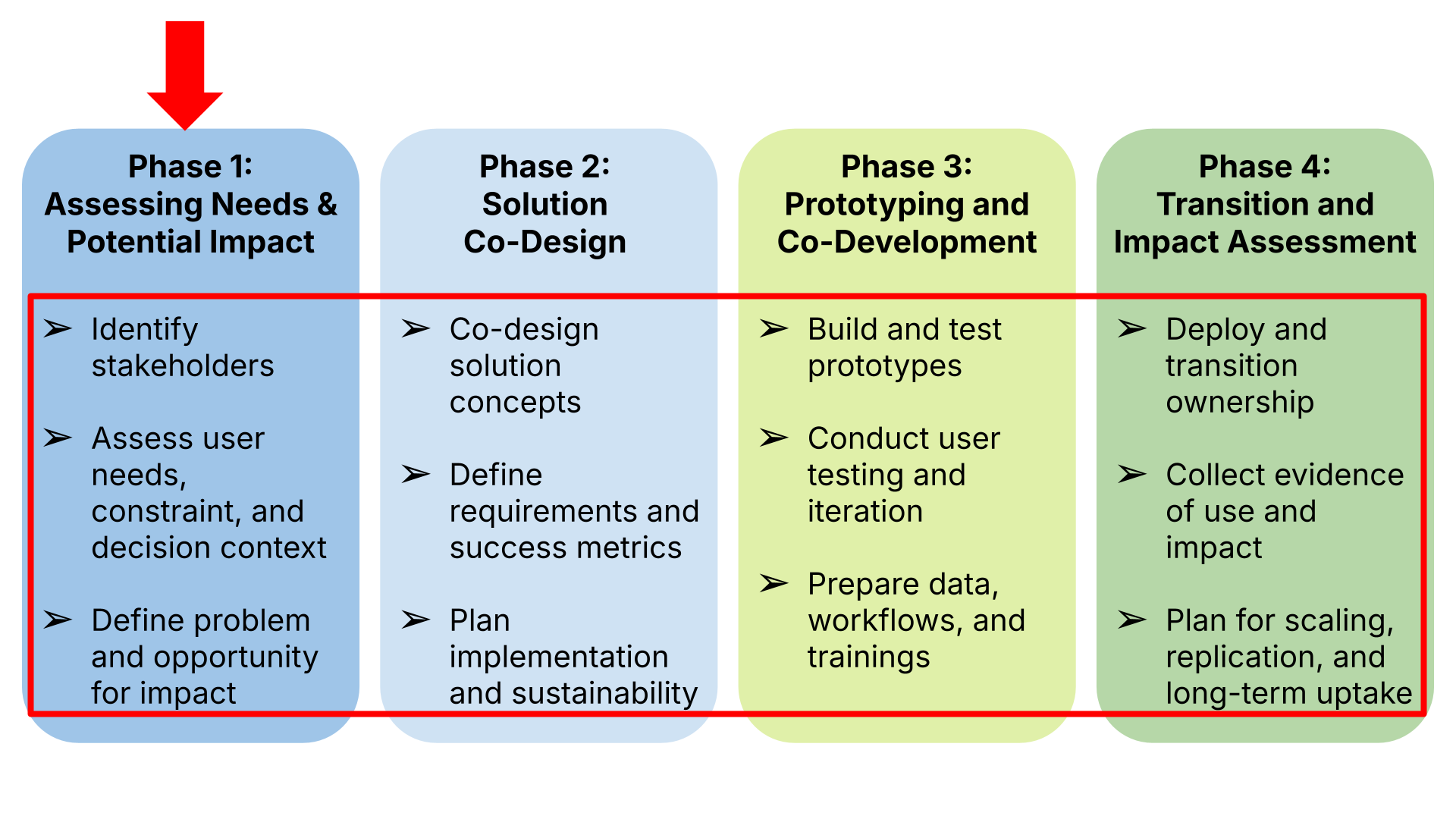
UCD considerations begin at the start of a project, but remain relevant across all phases of co-development:
- In early phases, it clarifies what must change in decision behavior.
- During prototyping, it structures interaction and threshold logic, or the level to which a solution makes clear when the user should take a specific action (like when to trigger a disaster alert).
- During validation, it tests whether predicted behavioral change occurs.
- During scaling, it ensures that decision support provided by the solution is unambiguous and easy to understand.
UCD does not replace Stakeholder Mapping, Needs Assessment, Information Flow Analysis, Designing for Impact, or Information Chain Analysis. UCD builds on those validated insights and translates them into design structure by answering a distinct question:
UCD therefore pays attention to the tangible, measurable benefits of prioritizing better design–like increased user satisfaction, reduced costs, enhanced accessibility, and higher retention. It shapes:
- Information hierarchy
- Clear logic and thresholds for when to make certain decisions
- The flow of how the user interacts with the system
- Feature prioritization
- Accessibility and usability
- Behavioral assumptions embedded in technical development
NASA Earth Action Solutions Co-Development Toolkit, v0.1 | 69
By focusing on performance at the point of use, UCD ensures that solutions do not merely deliver information, but enable correct interpretation and action under real operational conditions.
UCD in Practice: Building Decision-Anchored User Personas
UCD begins with decisions. Solutions are effective only when aligned to a specific action that someone must take within defined authority structures, constraints, and consequences. To identify these conditions, UCD relies on decision-anchored user personas informed by Phase 1 tools. Personas synthesize validated stakeholder and workflow findings into a structured, decision-ready representation that guides design.
Decision-Anchored User Personas: What They Are and Are Not
| What They Are | What They Are Not |
|---|---|
| A structured summary of decision conditions | A job description |
| An analytic representation of a role accountable for a specific action | A broad stakeholder category |
| Explicit about the decision, timing, authority, and consequence | A demographic or personality profile |
| Grounded in operational and interpretive constraints | A fictional narrative or backstory |
| Designed to anchor solution features to real workflows and accountability | An undefined "end user" without decision responsibility |
Limiting personas to the minimum necessary preserves analytic clarity and prevents feature sprawl.
NASA Earth Action Solutions Co-Development Toolkit, v0.1 | 70
UCD In Practice: Applying User Personas for Decision-Focused Design
Once user personas are defined, UCD proceeds through four operational steps reflected in the spreadsheet. The spreadsheet contains specific instructions for each of the following steps:
- 1 The decision context is clarified, defining the specific action, timing, authority structure, and consequences that shape real-world use.
- 2 The existing workflow is mapped to identify how the decision currently unfolds, including information sources, bottlenecks, interpretation burdens, and friction points.
- 3 The above insights are translated into explicit design requirements and behavioral hypotheses that specify how the solution must function to enable timely, correct action.
- 4 The proposed design is tested and refined under realistic conditions to ensure it performs within operational constraints. This four-step sequence is repeated for each persona to ensure that design logic reflects the distinct decision environments the solution must support.
UCD for Decision Readiness of EO-Solutions
UCD ensures that EO-enabled solutions are not merely scientifically sound, but decision-ready.
It translates validated stakeholder insights into structured design requirements tied to a specific decision, authority structure, and time constraint. It includes explicit hypotheses about how improved information delivery should influence behavior. And it tests those hypotheses under realistic conditions to determine whether the solution enables correct and timely action.
UCD is successful when design choices can be traced directly to a defined decision use case, when features support measurable improvements in decision performance, and when validation demonstrates reduced ambiguity, fewer interpretation errors, and faster time to appropriate action.
Without UCD, solutions risk providing data without ensuring it can be interpreted, trusted, or acted upon. With UCD, solutions are built to enable decisions.
NASA Earth Action Solutions Co-Development Toolkit, v0.1 | 71