
Information Chain Analysis
Purpose:
Even where the science is perfect, many solutions do not have the desired impact because:
- Information arrives too late, or not at all
- Messages are misinterpreted
- Channels exclude key groups or intermediaries
- Responsibilities at handoffs are unclear
- Assumptions about use go untested
An information chain analysis (ICA) makes these challenges visible, specific, and fixable by tying information flow directly to decisions, behaviors, and outcomes.
An ICA is a tool used to examine how information and data from a solution moves through a system to support specific decisions. It is intended to capture where that flow can break down in ways that matter for solution design, outcomes, access, and impact. It is informed by stakeholder mapping and needs assessment and is integrated in solution design, testing, and validation.
An ICA breaks down a broad decision into decision-specific pathways, to trace how information is generated, transformed, packaged, transmitted, interpreted, and ultimately used. In aggregate, these pathways create a full picture for how information flows to inform decisions.
The goal is actionable insight. The ICA helps with identifying potential gaps where breakdowns in information flow prevent informed decisions, and what must change in design, packaging, dissemination, or engagement to fix them. This has the added benefit of increasing opportunities for impact.
NASA Earth Action Solutions Co-Development Toolkit, v0.1 | 58
How and When to Use This Tool:
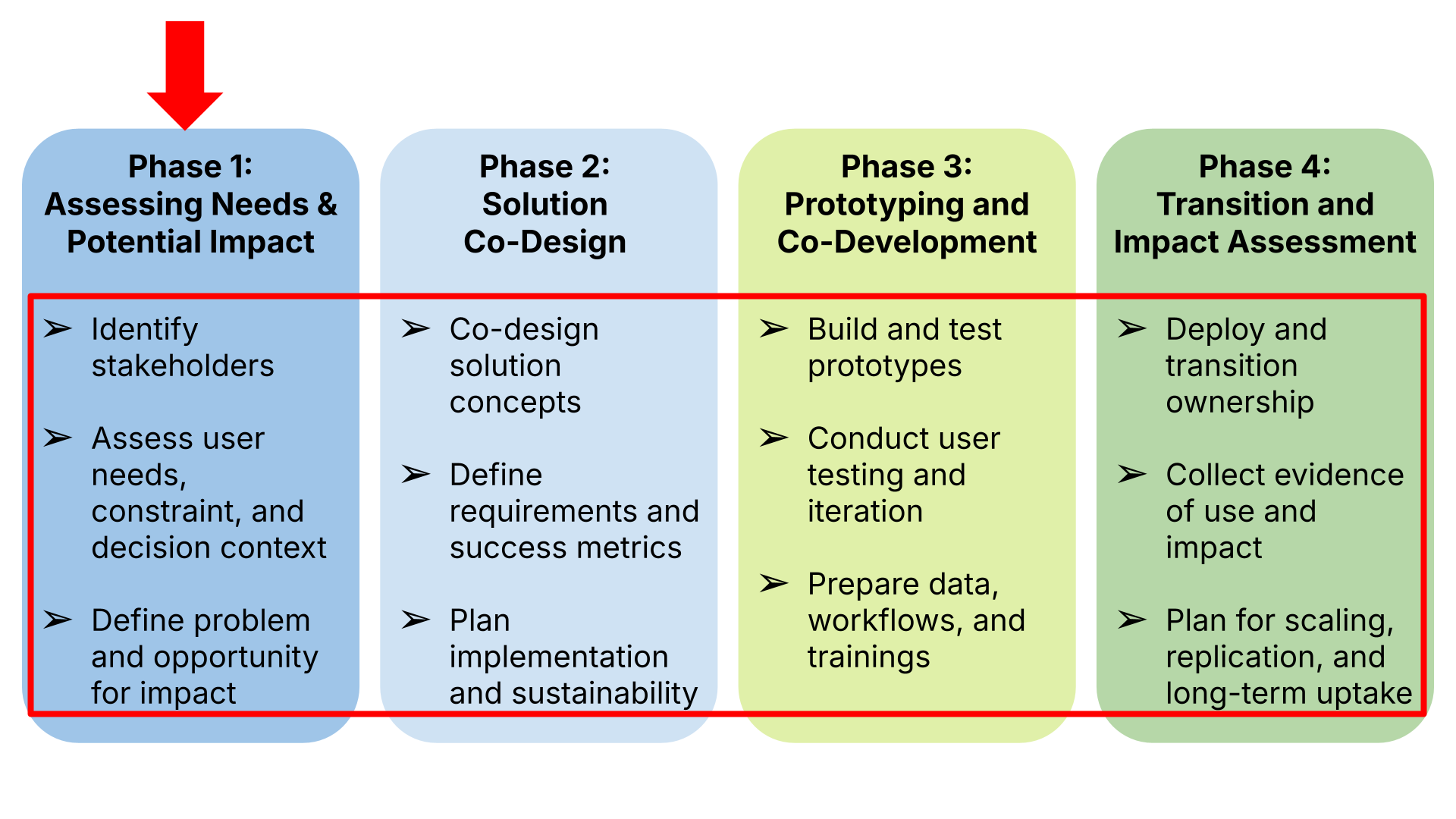
An ICA can be started during Phase 1 after stakeholder mapping and needs assessment are completed. During this phase, the ICA helps to sharpen understanding of stakeholder needs and constraints to help teams better understand practical limitations and opportunities for impact. However, consulting an ICA is useful throughout the lifecycle of a project, as outlined in the following table.
| Lifecycle Moment | What ICA Clarifies | What It Informs |
|---|---|---|
| Stakeholder Mapping and Needs Assessment Use once stakeholder insights and needs are available |
|
|
| Solution co-design Use in translating needs into solution concepts |
|
|
| Co-design & integration Use for aligning technical, institutional, and partner inputs |
|
|
| Development & early use Use for building, piloting, or refining solutions |
|
|
| Monitoring and Impact Assessment Use for defining metrics or impact monitoring questions |
|
|
Understanding Decision Pathways
An ICA focuses on decision-specific pathways rather than mapping entire information systems at once. Each ICA traces how information supports one decision, even if multiple sources or channels converge at that point. Over time, multiple ICAs can be layered to reveal the broader information system and recurring bottlenecks. If an analysis spans multiple decisions, it should be split to preserve clarity and actionability.
For each decision pathway, an ICA traces only the information that is necessary for one specific decision, following it step by step from source to action. At each step, the analysis asks:
- Where does the information needed for this decision originate?
(e.g., which EO datasets, models, reports, or observations are relied upon) - Who interprets or translates it—and how?
(e.g., analysis, aggregation, contextualization, or judgment applied before it becomes decision-relevant) - How is it delivered to the decision-maker, and when?
(e.g., format, channel, frequency, and timing relative to the decision window) - Who is expected to act on it, and under what constraints?
(e.g., authority, incentives, capacity, institutional rules)
NASA Earth Action Solutions Co-Development Toolkit, v0.1 | 60
In an ICA, a decision pathway defines what is being analyzed: the sequence of information flows required to support one specific decision. Chain links define where analysis occurs within that pathway.
Each chain link represents a moment of transition along a decision pathway—a point at which information changes form, moves between actors, or crosses an institutional or technical boundary. An information chain often follows a sequence such as: EO product generation → analyst interpretation → advisory or alert formulation → channel transmission → decision-maker uptake.
Mapping a pathway as a series of chain links allows ICA to pinpoint exactly where information may be delayed, distorted, or lost as it moves toward a decision. By breaking the pathway into discrete links, the analysis clarifies who is responsible at each step and under what conditions information is handed off or transformed. This, in turn, makes it possible to distinguish whether failures arise from solution design, institutional capacity, incentives, timing constraints, or barriers to access, enabling targeted, corrective or preventative action.
Importantly, ICA does not assume that all links function equally well. A decision pathway may be technically sound overall but still fail because of one or two critical weak links. By making chain links explicit, ICA enables targeted design and delivery actions focused on the points where intervention will have the greatest impact.
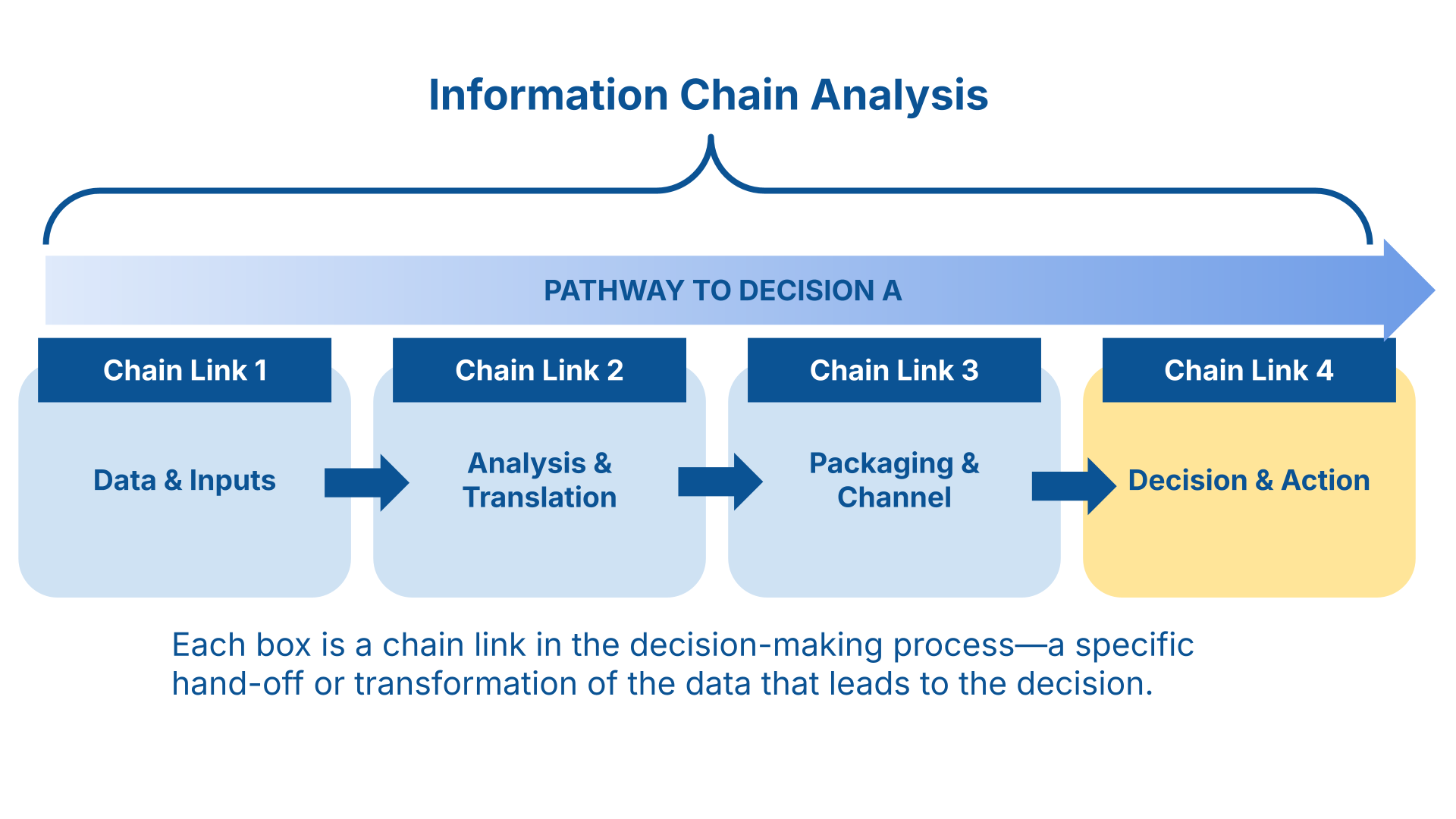
Each box is a chain link in the decision-making process—a specific hand-off or transformation of the data that leads to the decision.
Fig. 1 Illustration of chain links constituting a decision pathway
NASA Earth Action Solutions Co-Development Toolkit, v0.1 | 61
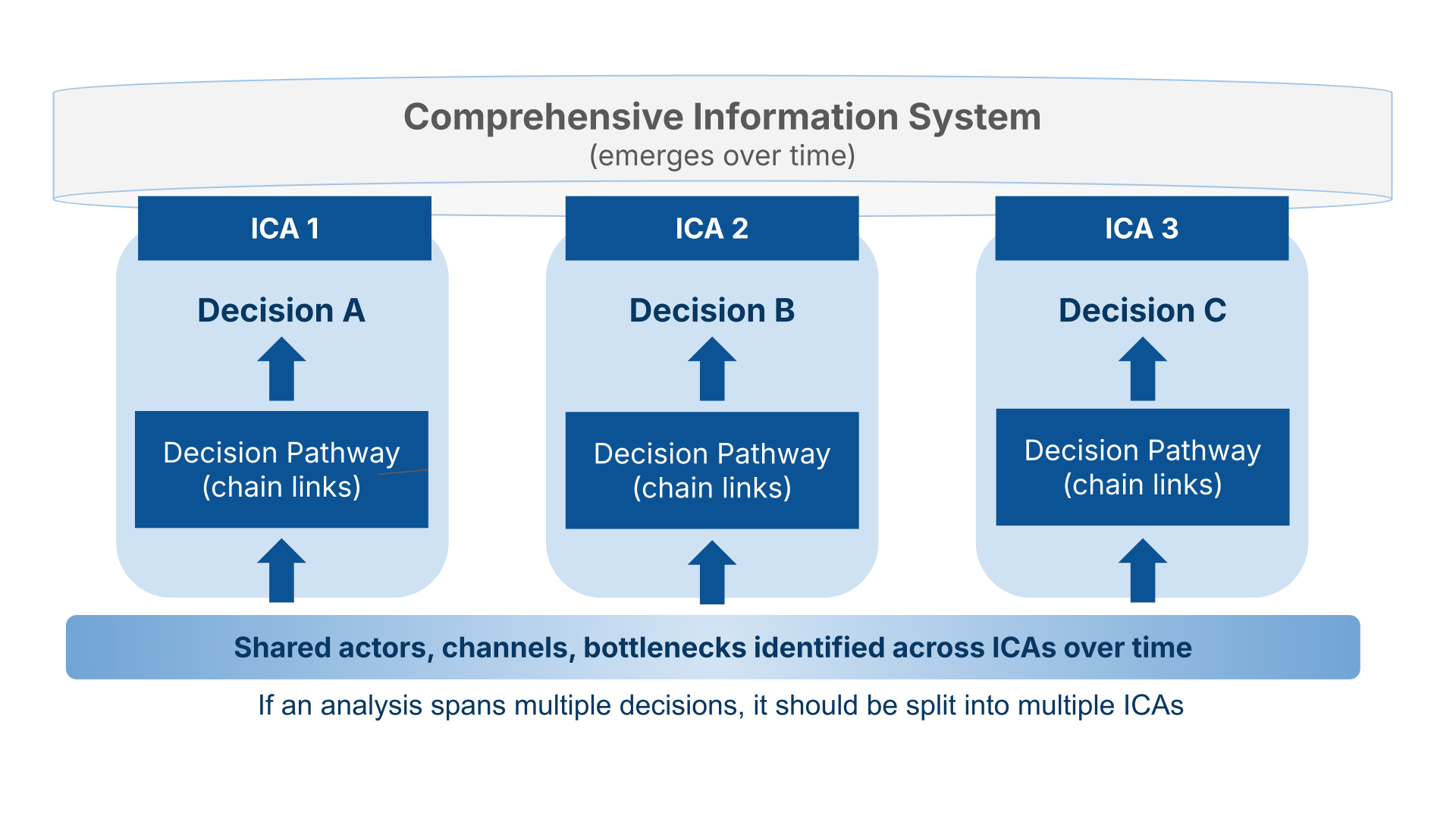
If an analysis spans multiple decisions, it should be split into multiple ICAs
Fig. 2 Visualization of how decisions based on decision pathways lead to a comprehensive information system
Information Channels and Target Audiences
Because ICA traces how information moves from data to decisions, it is essential to consider both who participates in information flows and how information is communicated along the decision pathway.
EO-derived information often changes form multiple times—from data to analysis, from analysis to alerts, and from alerts to action. Many failures occur not because EO data are inaccurate, but because information is misinterpreted, delayed, or transmitted through channels that users cannot access or do not trust.
Actors who produce, translate, transmit, or act on information include:
- Technical and communications staff (science, data, IT, communications)
- National, regional, and local government departments
- Disaster management agencies and Emergency Operations Centers (EOCs)
- NGOs, CSOs, and implementing partners
- Extension services and field officers
- Community leaders and representatives
- End users and affected community members
- Donors and coordinating bodies (where relevant)
NASA Earth Action Solutions Co-Development Toolkit, v0.1 | 62
Note that different actors may appear multiple times in the chain with different roles.
Common Channels for Sharing EO-Enabled Information
Broadcast and print
- Radio, television, newspapers, public service announcements
Digital and mobile
- Websites and dashboards
- Email and data portals
- Mobile apps
- SMS, WhatsApp, and other messaging platforms
Institutional and operational
- Briefings, situation reports, internal memos
- Coordination meetings and command centers
Community-based and informal
- Community boards and local announcements
- Town meetings, markets, roadside signs
- Trusted intermediaries (local leaders, extension workers)
Feedback and response channels
- Hotlines, reporting apps, community meetings, forums
- Which stakeholders rely on which channels—and at what stage?
- Where are bottlenecks, delays, or points of distortion?
- Are channels one-way (broadcast) or two-way (interactive)?
- Do accessibility, literacy, language, or connectivity constraints limit use?
- Do users understand and trust the information?
- Are informal channels complementing or substituting for formal ones?
ICA in Practice: Conducting an Information Chain Analysis
To conduct an ICA, follow the steps outlined in the instructions on this Excel ICA Worksheet
If you prefer to follow the written steps only, you can reference the step-by-step document.
Purpose: Define a single, decision-anchored information pathway to prevent scope creep and analytic drift.
NASA Earth Action Solutions Co-Development Toolkit, v0.1 | 63
Define (before mapping):
- Decision to be supported
- Decision-maker (individual or body)
- Decision timing
- Intended beneficiary / end user
- Information product(s) informing the decision
- Consequence of failure if information is delayed, distorted, or missing
Example
- Chain 1 Decision: Activate district flood preparedness measures
- Decision-maker: District Disaster Management Committee
- Timing: 24–72 hours before peak flooding
- Information product: Flood forecast and alert bulletin
- Consequence of failure: Delayed evacuation increases risk to life
- Chain 2 Decision: Inform resilience planning efforts
- Decision-maker: State Climate Resilience Office
- Timing: Post-event
- Information product: Flood expansive maps and socio-economic data layer
- Consequence of failure: Repeated flood events
Purpose: Create a shared, chronological map of how information moves and is interpreted from production to use.
Method
- Break the pathway into chain links (C1, C2, C3…)
- Each link represents a handoff, where information:
- Moves to a new actor or authority, and/or
- Is interpreted, translated, or acted upon, changing its meaning, level of instruction, or decision implication
- Capture both:
- The information received, and
- The decision or interpretation applied at that step
- Stop when information reaches the intended user with a clear, actionable instruction.
NASA Earth Action Solutions Co-Development Toolkit, v0.1 | 64
Clarification
Information chains do not only transmit data; they progressively convert signals (e.g., forecasts or alerts) into decisions and directives (e.g., prepare, evacuate, shelter). These interpretation points are often where failure or confusion occurs and must be explicitly mapped.
Example (Flood Evacuation Decision)
Interpretation: Determine national alert level
Interpretation: Decide whether evacuation thresholds are met
Interpretation: Translate decision into local instructions and channels
Interpretation: Households understand what action to take (evacuate vs. prepare)
Purpose: Identify where the chain could potentially fail in practice.
For each step, examine:
- What must go right
- What actually happens
- The type of breakdown (delay, capacity, access issue, lack of trust, distortion)
Building on the flood evacuation example above:
- C2: Alerts translated too slowly on weekends → Delay
- C4: WhatsApp excludes elderly → Access barrier
NASA Earth Action Solutions Co-Development Toolkit, v0.1 | 65
Purpose: Filter issues to those that materially affect decisions and outcomes.
Prioritization criteria:
- Impact on decision quality or timing
- Impact on outcomes
- Impact on equity or access
Output
A short list of high-impact issues that move forward.
Example
- C4 access barrier affecting elderly households → High priority (prevents evacuation)
Purpose: Translate prioritized issues into actionable interventions.
For each priority issue, specify:
- Intervention type (design, delivery, engagement)
- Concrete action
- Responsible actor
- Implementation phase (co-design, pilot, deployment)
- One chain link
- One prioritized issue
Example
- C2 delay → Delivery → Automate SMS alerts to district leads (National DRM)
- C4 access barrier → Delivery → Add radio announcements targeting elderly households
- C4 trust issue → Engagement → Train community leaders on key messages
NASA Earth Action Solutions Co-Development Toolkit, v0.1 | 66
Purpose: Make implicit assumptions explicit and testable.
Assumptions should be extracted from earlier steps—not brainstormed from scratch—and paired with:
- The risk (if false)
- How the assumption will be monitored or tested
These assumptions inform results framework indicators and MEL questions.
Example
- C3: Assumes district staff act on alerts immediately → Risk if false = no evacuation → Monitor via post-event staff meetings
- C4: Assumes NGOs disseminate messages promptly → Risk if false = late info → Monitor via periodic, randomized checks
NASA Earth Action Solutions Co-Development Toolkit, v0.1 | 67